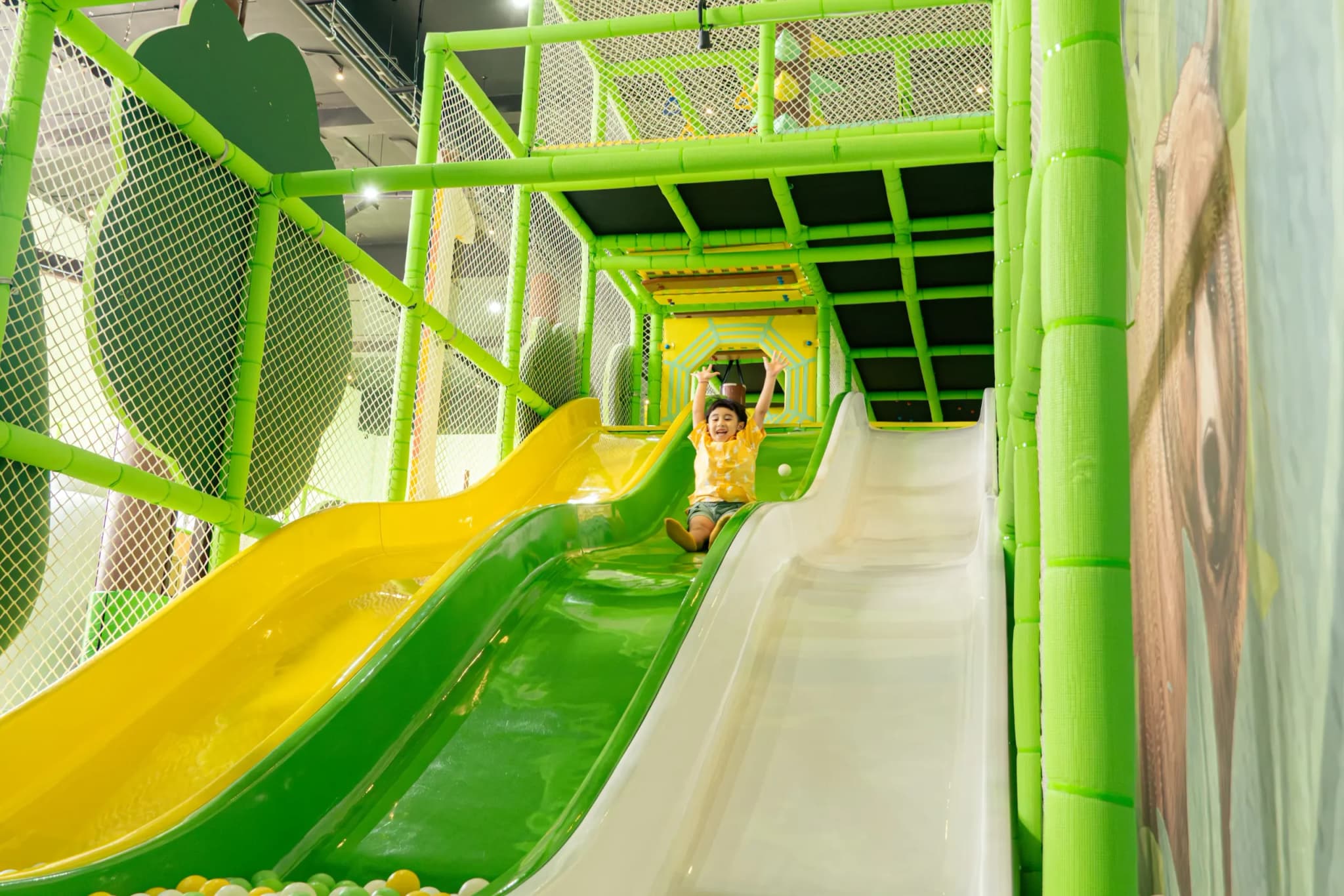
The benefits of a playground extend far beyond mere playtime. These spaces support child development and fill a crucial gap, especially in today’s world, where academic pressure and excessive screen time leave many children with fewer opportunities for structured outdoor activities.
This article explores how playgrounds can make a significant impact on your little one’s growth, offering insights for parents curious about the subject.
How Playgrounds Support Physical Development
Having healthy kids with good physical development is a lovely dream for every parent. Playgrounds offer a wide range of facilities that actively support motor skills and help build children’s physical strength.
Building Gross Motor Skills
A study titled “The Impact of Outdoor Play on Motor Skill Development in Early Childhood: A Systematic Literature Review,” published in the Journal of Foundational Learning and Child Development (2025), looked at how different types of outdoor play affect motor development in young children. It found that structured outdoor play produces significant improvements in specific motor skills, while unstructured free play in natural settings supports children’s movement creativity.
Physical activities at the playground, such as sliding, swinging, running, and jumping, are highly effective for developing a child’s gross motor skills. These activities engage the large muscle groups that play a key role in physical development, balance, and body coordination.
Strengthening Fine Motor Skills
Besides gross motor skills, fine motor skills are another area that benefits from playground activities. Fine motor skills refer to the body’s ability to coordinate small muscles, such as those in the fingers and wrists, along with hand-eye coordination.
Even though playgrounds are often associated mainly with big physical movements, many of them are also designed to stimulate a child’s fine motor skills. This kind of development can come from simple activities, such as playing with sand or stacking blocks.
Encouraging Daily Physical Activity
Playgrounds are specifically designed as spaces for children to play, naturally encouraging motor movement while keeping things fun. Unlike structured exercise, which can feel tiring or like a chore to kids, a playground lets children stay physically active without feeling like they’re exercising at all; it feels more like exploring.
Playgrounds are also typically built with a variety of features designed to offer exciting motor challenges. These spaces give children a place to explore safely and freely, play with friends to build social confidence, cut down on screen time, and support overall fitness.
How Playgrounds Support Social and Emotional Development
Playgrounds also shape a child’s social and emotional development. Research shows that these spaces help kids build social skills and manage their emotions through direct interaction with the peers they meet while playing.
Building Social Skills Through Peer Interaction
According to NRPA (National Recreation and Park Association), spending time outdoors in spaces like playgrounds and parks has a positive effect on social interaction for both adults and children, along with an overall improvement in social skills.
At the playground, children typically meet peers their own age. This helps them build everyday social habits, such as sharing and taking turns with equipment, while also learning to greet, chat, listen, and respond to what their friends say.
These moments also teach kids to negotiate and problem-solve when equipment is in demand, while working together during group games.
Processing Emotions Through Active Play
Playgrounds also give children an important space to build emotional regulation through active play. This setting supports emotional release through a mix of physical activity, social interaction, and independent exploration.
Active play isn’t just about movement; it’s also how children learn to manage their emotions. According to a clinical report from the American Academy of Pediatrics (AAP), physical play encourages children to communicate and negotiate with playmates. It also teaches empathy, since kids are guided not to hurt one another. This process helps children understand their own boundaries and those of others, shaping more mature emotional responses.
One study cited in that same AAP report found that anxious 3- to 4-year-olds facing the start of preschool showed a twofold decrease in anxiety after just 15 minutes of play, whether with toys or with peers. Children who only listened to a teacher read a story showed no similar drop. This suggests that time spent playing, including time at a playground with other kids, can be a meaningful moment for learning to regulate emotions.
Building Confidence and Self-Esteem
Confidence and self-esteem are essential parts of a child’s development. These traits can be nurtured by giving kids a safe space to face physical challenges, work through setbacks, and interact socially.
When a child plays at the playground and manages to complete a challenge, such as climbing a rope net or going down a tall slide, their brain registers that success as an achievement, shaping their confidence and sense of capability.
This kind of confidence-building isn’t limited to typically developing children. A scoping review from Universitas Gadjah Mada (2025) looked specifically at how playgrounds affect the mental health of children with disabilities.
The findings were mixed: playgrounds were linked to gains in social skills, self-confidence, and emotional wellbeing, but poorly designed spaces could also contribute to social isolation or lower self-esteem. The study’s takeaway was that inclusive playgrounds, ones built with both physical and social accessibility in mind, are what make that difference.
How Playgrounds Support Cognitive Development
Cognitive ability refers to a set of brain functions involved in thinking, learning, remembering, and understanding information. These abilities are especially important during childhood because they form the foundation for how children process information, think logically, and solve problems in everyday life.
Problem-Solving Through Unstructured Play
Problem-solving is one of the essential skills that should be developed as part of a child’s cognitive growth. It helps children learn to think logically and creatively while becoming more independent when dealing with different situations and challenges.
Unstructured play at the playground, especially without constant direction from adults, can be a natural way to strengthen these problem-solving skills. Without step-by-step instructions or rigid rules, children have more opportunities to make their own decisions, assess situations, and figure out what to do next. This process helps develop their cognitive abilities through play.
For example, children often encounter physical challenges at the playground that they need to work through on their own. They may need to decide whether a ladder feels too high to climb, figure out how to cross a suspended bridge without losing their balance, or choose a different way to complete an obstacle when their first attempt does not work.
Encouraging Creativity and Imagination
If you still think creativity and imagination only develop when children play alone with their own ideas, that is not necessarily the case. Playing at a playground can also give children plenty of opportunities to use their imagination and think creatively.
A literature review on creativity in playgrounds suggests that play environments can support creativity when they give children the freedom to change, experiment, choose, and imagine how they want to play.
Playgrounds can provide flexible and open-ended environments that children can use in different ways. Instead of simply following the intended function of each piece of play equipment, children can create stories, engage in role-play, solve problems, and interpret their surroundings according to their own imagination.
For example, a play structure such as a tunnel or climbing tower can become part of an imaginary adventure, where children pretend to be explorers, superheroes, or characters in a story they create themselves. They can also choose their own ways of using the equipment around them, making each play experience slightly different from the last.
Supporting Focus and Learning Beyond the Playground
The benefits of playground time do not necessarily end once children finish playing and go home.
Activities such as building, climbing, completing challenges, and playing with other children can also strengthen attention, problem-solving, self-control, and the ability to follow instructions. These are skills that children can carry with them when they return to learning activities at home or at school.
For instance, completing an obstacle course requires children to stay focused on their movements and work through a challenge until they reach the end. Building with blocks can teach them to try again when a structure falls apart, adjust their approach, and keep working toward the result they want.
The experiences children gain through playground activities can therefore carry over into learning at home and at school. Skills practiced through play can show up in everyday situations, from concentrating on an assignment and listening to instructions from parents or teachers to working with classmates and finding solutions when they encounter a problem.
What to Look for in a Playground That Supports Development
After understanding why playgrounds can be important for a child’s development, parents also need to make sure the playground they choose can actually support that growth. Not every playground automatically provides the same developmental benefits, especially when the environment is unsafe, poorly maintained, or not suitable for the child’s age.
When choosing a playground, there are several things parents can look for to make sure the space supports both safe and meaningful play.
A Variety of Play Zones for Different Skills
A good playground should offer a variety of play zones that support different areas of a child’s development. Every child develops at a different pace and may be interested in different types of activities.
A more varied play environment gives children the chance to develop different skills through play, alongside simply having fun.
Look for areas that support gross motor skills, such as slides, swings, climbing nets, and other equipment that encourages larger body movements. It is also helpful to have sensory play areas, fine motor and manipulative activities, and other zones that allow children to explore different ways of learning and moving.
Equipment Suited to Different Age Groups
Choose a playground with equipment designed for different age groups. Each stage of childhood comes with different levels of physical ability, coordination, and safety needs. Equipment that is suitable for a child’s age can make play safer while also providing challenges that match their current abilities.
This helps prevent children from feeling overwhelmed by equipment that is too difficult or getting limited developmental value from activities that are too easy for them. Age-appropriate play areas allow children to explore, practice new skills, and gradually take on more challenging activities as they grow.
A Safe Environment That Encourages Independent Exploration
Children naturally move, climb, run, and explore freely when they are at a playground. Because of this, safety plays an important role in giving them the freedom to explore with greater confidence.
A well-designed and well-maintained playground can help reduce the risk of injuries, including falls, fractures, or more serious accidents during active play. Parents should look for playgrounds with sturdy equipment, appropriate safety surfaces, intact play structures, and layouts that allow children to move around safely.
When children feel secure in their surroundings, they have more freedom to explore independently, try new challenges, and learn through their own experiences.
Give Your Child the Benefits of Playground Play
The benefits of playgrounds go beyond simply giving children time to play and parents a chance to take a short break while watching over them. More than just a source of fun, playgrounds can support physical, social, emotional, and cognitive development all at once.
Parents should make sure the playground they choose is safe, age-appropriate, and offers a variety of play zones that support different areas of development. At Mai Main Playground Canggu, you can find all of these qualities while giving your little one a day that is both fun and meaningful for their growth.

