Watching traditional Balinese dance is a captivating experience. UNESCO even recognized Balinese dance as an Intangible Cultural Heritage of Humanity in 2015, which gives the dance special significance for cultural performance.
In this article, you will find an in-depth explanation of the types and history of Balinese dance. This article explores traditional Balinese dance to enrich your cultural knowledge.
The History of Balinese Dance

Enriching your cultural knowledge of Balinese dance history helps you understand this art performance, because Balinese dance has a deep-rooted history, dating back more than a thousand years.
Early forms of dance in Bali were heavily influenced by ancient animist traditions, as movement and rhythm were used in ceremonies to honor spirits and seek protection from nature. It is what makes Balinese dance recognized by UNESCO as a heritage.
As Hinduism spread from India to Indonesia around the 8th to 14th centuries, Balinese dance evolved even more. Hindu epics like the Ramayana and the Mahabharata inspired many traditional dance dramas still performed today.
Gradually, dance became an important part of temple ceremonies, royal entertainment, and community celebrations across Bali. Royal palaces became cultural centers, where dancers trained in precise eye movements, expressive hand gestures, and rhythmic coordination with gamelan music.
Many types of Balinese dance known today were shaped during this period, including Legong, Baris, Gambuh, and Topeng. It is rooted in Bali’s ancient history, which makes the dances have a deep meaning for Balinese people to this day.
Main Types of Traditional Balinese Dance

The culture is still preserved to this day, as it helps you see the main types of traditional Balinese dance. These traditional dances have physical characteristics and origins, making each dance unique with its own distinctive movements and symbolism.
1. Legong Dance
Legong dance in Bali is one of the most refined and graceful classical dances from Bali. It originated in the royal palaces of Bali during the 19th century. Particularly, it is in areas connected to royal courts such as Ubud and Gianyar.
This dance is famous for its detail and expressive movements. Some of its most recognizable characteristics include sharp, precise eye movements, intricate finger gestures, fast footwork, graceful posture, and synchronization with gamelan rhythm.
Traditionally, Legong Dance was performed by young girls because softness, flexibility, and delicate expression were considered essential. Today, Legong dancers are usually female dancers trained from a young age, students from Balinese dance schools, and professional cultural performers.
Legong Dance Bali is typically performed during temple ceremonies, cultural festivals, traditional celebrations, or even evening cultural shows for visitors. You can see this dance when visiting the performance central area in Ubud or Uluwatu.
2. Kecak Dance (Fire Dance)
Kecak Dance Bali was developed in the 1930s through a collaboration between a Balinese artist and German painter Walter Spies. It was inspired by the ancient Balinese sacred ritual called Sanghyang, a ceremonial performance used to ward off negative spirits and restore spiritual balance within the community.
The most noticeable feature of this dance is the ” cak-cak-cak-cak” chanting from the performers. It is performed within a large circle formation of chanting men, rhythmic vocal percussion, dramatic fire elements, and epic storytelling scenes.
A traditional Kecak Dance Bali usually includes 50 to 100 males forming the chorus. The main character dancers represent Rama, Sita, Hanuman, and Ravana. In the climax scenes, fire performers light the fire.
Commonly, this dance is performed during Sunset in Uluwatu or at cultural venues. You can also watch the Kecak Dance in temple amphitheaters and during tourism and cultural events.
3. Barong Dance
Barong Dance Bali comes from ancient pre-Hindu animist tradition in Bali and is blended with Hindu influences. Traditionally, this dance performance was connected to temple rituals and spiritual ceremonies to protect from negative energy.
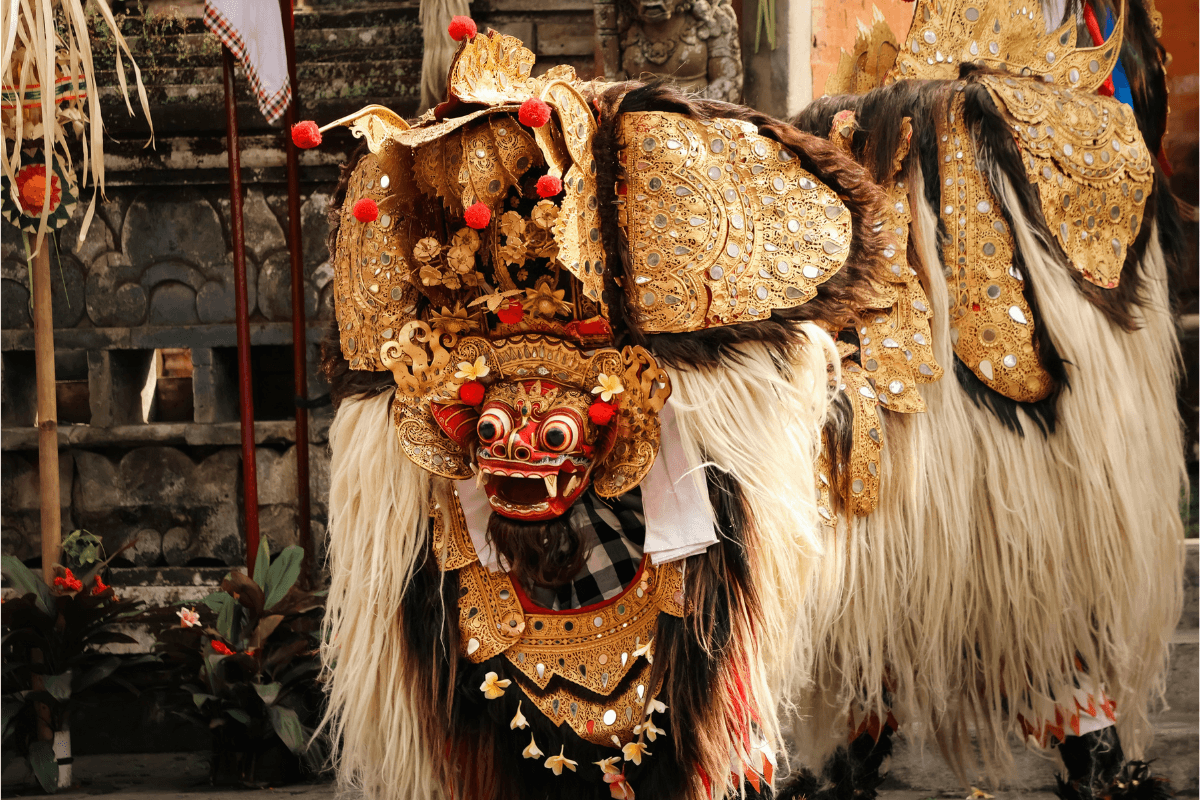
This dance is known for its dramatic costumes, expressive masks, and energetic storytelling. This Balinese dance costume features thick fur decorations, gold ornaments, large bulging eyes, a moving jaw mechanism, and decorative mirrors and beads.
Usually, Barong Dance Bali performances involve two performers inside the Barong costume, dancers portraying Rangda and supporting characters. It is also accompanied by gamelan musicians and comedy characters as well as villagers in the storyline.
Barong Dance is commonly performed during temple ceremonies. Also, it is performed for religious festivals, cultural events, and daily cultural shows for visitors. You can find this dance in tourism hotspots like Ubud, Uluwatu, and Gianyar.
4. Pendet Dance
Pendet Dance is a Balinese dance with deep meaning and symbolism. It was traditionally performed inside temples by women carrying flower offerings as a symbol of devotion, gratitude, and respect. Over time, Pendet Dance evolved into a cultural welcoming dance for greeting guests in a ceremony
The dance is known for its graceful and welcoming movements. You can see gentle hand gestures, rhythmic shoulder and eye movements, and slow flowing choreography from the dancers.
Unlike some classical dances, Pendet Dance is often taught early in Balinese dance education because it represents the foundation of graceful Balinese movement. So, you will see the dance performed by female dancers, young girls or women, and temple community members.
Pendet Dance is typically performed in temple ceremonies, religious festivals, cultural celebrations, and tourism performances. Many venues offer performances of this dance, such as Ubud, Gianyar, Uluwatu, Denpasar, and Balinese temples.
5. Topeng Dance
Topeng Dance or Mask Dance dates back centuries and was originally connected to royal courts and temple ceremonies. It was used to tell stories about Balinese kings, historical figures, mythology, and moral lessons. It also served as spiritual offerings in religious events.
The masks usually portray kings and nobles, warriors, priests, villagers, and mythological characters. You can see how dramatic the gestures are from the dancers. It uses expressive posture and stylized walking patterns as well.
Usually, the Topeng Dance is performed by male dancers, highly trained traditional performers, and cultural-temple artists. But female performers also participate in the performance.
In Dewata Island, this type of Balinese dance is performed during temple festivals, religious ceremonies, cultural events, or even traditional celebrations. This dance can be found in Ubud, Gianyar, Denpasar, and cultural performance halls.
6. Baris Dance
As a traditional Balinese dance, Baris Dance portrays traditional warriors that symbolize courage, heroism, and the spirit of Balinese warriors before battle. Baris itself comes from the Balinese term for ‘line’, referring to the military formations used by soldiers.
The dance is known for its strong, energetic, and masculine movements that imitate the behavior of a warrior preparing for combat. The key characteristics include sharp eye movements, powerful footwork, dynamic poses, and controlled weapon handling.
Baris Dance is traditionally performed by male dancers, young men trained in classical Balinese dance classes, and temple community performers. It requires physical stamina, strong posture control, and rhythmic precision.
Usually, this dance is performed in religious festivals, temple ceremonies, and traditional processions. You can see the performance when visiting Balinese hotspot area, like Ubud, Gianyar, and Denpasar.
Where to Watch Traditional Balinese Dance in Bali

You may wonder, “Where to watch Balinese dance?” that still shows the originality. You can visit several places below and include them in your 7-day Bali itinerary.
1. Puri Saren Ubud (Outdoor Palace Setting)
Puri Saren Ubud is known internationally as the Ubud Royal Palace. It is one of the most iconic places to watch traditional Balinese dance with an authentic outdoor palace setting. The palace combines royal Balinese architecture and a traditional courtyard, creating a truly atmospheric cultural experience.
Watching Legong, Topeng, Barong, or even Kecak dance in Puri Saren Ubud can be a fun activity for kids in Bali. It helps them understand the Balinese dance meaning and symbolism, enriching their cultural knowledge.
2. ARMA Museum
More than just an art Museum, Agung Rai Museum of Art (ARMA) is one of the best cultural destinations in Ubud. This place functions as a living cultural center dedicated to preserving Balinese heritage.
The venue regularly hosts traditional dances like Legong Dance, Barong Dance, Pendet Dance, and even Topeng Dance. Dancers perform it in a peaceful garden setting, surrounded by Balinese architecture, lotus ponds, and tropical greenery.
3. Tirta Sari
Answering the question “Where to watch Balinese dance?” You can visit Tirta Sari, which is one of the most respected traditional dance groups and cultural performance venues in Ubud.
Founded by Balinese artists, Tirta Sari has played an important role in introducing traditional Balinese dance to international audiences. It also maintains strong cultural integrity.
Besides performing arts, Tirta Sari also becomes a place that offers Balinese dance classes for tourists. Participants can learn basic Balinese hand gestures, eye and facial expressions, and even traditional body posture. It is a perfect indoor activity for kids in Bali.
4. Ubud Palace
Situated in the heart of Ubud, this palace is known as Puri Saren Agung. It has become one of the most iconic cultural landmarks that hosts traditional Balinese dance performances for tourists and locals.
The palace is famous for its nightly Balinese dance performances accompanied by live gamelan music. Common dances regularly performed here are the Legong Dance, Barong Dance, Topeng Dance, and Kecak Dance.
5. GWK Cultural Park
Garuda Wisnu Kencana (GWK) Cultural Park is one of the largest cultural and tourism destinations in Bali. It is located in the southern part of Bali near Uluwatu. Besides its famous Vishnu riding the mythical Garuda bird, the place also offers a show of cultural performances.
GWK regularly hosts traditional Balinese dance shows and cultural performances. Visitors can experience a variety of performances, including Kecak Dance, Barong Dance, Pendet Dance, and any contemporary Balinese cultural shows.
6. Uluwatu Temple (Kecak at Sunset)
Perched on the top of limestone cliffs, Uluwatu Temple is one of the most iconic cultural and spiritual landmarks in Bali. It has breathtaking ocean views and a sacred temple atmosphere. The site is famous for its sunset Kecak Dance performances.
You can watch the Kecak Dance at Uluwatu during sunset, leaving you mesmerized by the beautiful Kecak movements and unforgettable cultural experiences. It combines storytelling, chanting, fire performances, and panoramic coastal scenery in one setting.
Let’s Introduce Kids to Traditional Balinese Dance

All the traditional Balinese dances have their own origin story, as it is deeply rooted in Bali philosophy and symbolism. Each curated dance shows how humans interact with spirits and nature, and strengthens the harmony between them.
To let your kid explore Balinese culture, you can take them to Mai Main Playground. We have a special session of a Balinese culture event every Thursday. Dive into the session and don’t miss the opportunity to learn Balinese culture in a fun way.

